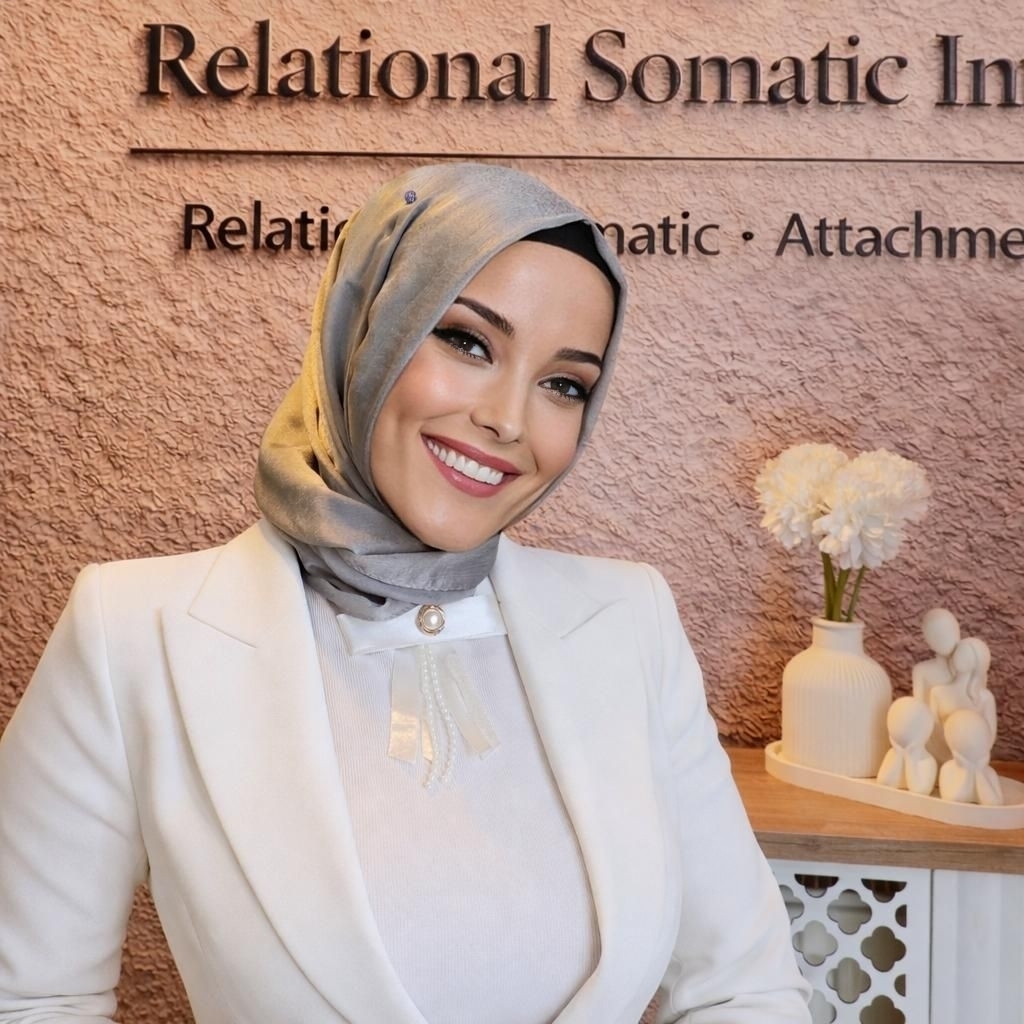
Founder profile · RSI™ LondonKurucu profili · RSI™ London
B. Rumeysa
Demirörs, MSc
Psychologist · Trauma & Attachment-Focused Psychotherapist · Researcher · Founder of RSI™Psikolog · Travma ve Bağlanma Odaklı Psikoterapist · Araştırmacı · RSI™ Kurucusu
Her work brings attachment, developmental trauma, nervous-system regulation, somatic experience and relational safety into one clinically coherent frame.
Çalışmaları bağlanma, gelişimsel travma, sinir sistemi regülasyonu, bedensel deneyim ve ilişkisel güvenliği klinik açıdan tutarlı tek bir çerçevede buluşturur.
Clinical philosophy
A professional stance shaped by listening, relationship and ethical clarity.
For me, psychology is less a field of techniques, diagnoses or memorised phrases than a threshold at which a person may truly come into contact with themselves. My professional stance has therefore grown from a place that does not rush: a place able to wait, listen and hold what is present without forcing it into a predetermined answer.
I understand a person through the wholeness of their life story, relational experience and embodied existence—not only through symptoms or diagnostic categories. Methods matter, yet their meaning emerges through the quality, safety and ethical boundaries of the relationship in which they are offered.
Many psychological difficulties can be understood not as personal inadequacies, but as adaptations to developmental conditions, relational experiences and early needs that could not be adequately met. My work therefore prioritises understanding, accompaniment and the creation of a safe ground over blame or correction.
Knowledge has power; knowing where knowledge must stop is part of that power.
Ethics, for me, means more than following professional rules. It means protecting boundaries, remaining aware of competence and being transparent about the scope of every role and service. I define my fields of work clearly and do not imply that a clinical service is available when it is not actively being provided.
I do not present professional knowledge as a single truth that fits everyone. Each person has a distinct story, rhythm and pathway of recovery. My approach respects this individuality and aims to strengthen internal resources, relational safety and the capacity for regulation.
Across academic work, clinical observation and education, my aim has been to make psychological knowledge accessible without reducing it, and to deepen it without making it unnecessarily obscure. In trauma and attachment work, I want human potential to remain as visible as human vulnerability.
My work focuses primarily on developmental trauma, early attachment injuries, regulation difficulties and intergenerational trauma transmission. I integrate attachment-informed, developmental and body-oriented perspectives within clinical work, professional education and supervision.
I continue my professional development in line with UK ethical and CPD expectations. I regard continuing education not as a formal obligation, but as a central responsibility for the safety and quality of the therapeutic relationship. To practise is not to be finished; it is to keep developing a more mature professional stance.
Klinik duruş
Dinleyebilen, ilişkiyi önemseyen ve etik açıklığa dayanan bir mesleki duruş.
Benim için psikoloji; tekniklerin, tanıların ya da ezber cümlelerin alanı olmaktan çok, insanın kendiyle ilk kez gerçekten temas edebildiği bir eşik demek. Bu nedenle mesleki duruşum acele eden bir yerden değil; bekleyebilen, dinleyebilen ve olanı olduğu gibi tutabilen bir yerden şekillendi.
İnsanı yalnızca tanı, semptom ya da teknikler üzerinden değil; yaşam öyküsü, ilişkisel deneyimleri ve bedensel varoluşuyla bir bütün olarak ele alıyorum. Yöntemler önemlidir; fakat anlamlarını, sunuldukları ilişkinin niteliği, güvenliği ve etik sınırları içinde kazanırlar.
Yaşanan zorlukları kişisel bir yetersizlikten ziyade, çoğu zaman gelişimsel koşulların, ilişkisel deneyimlerin ve erken dönem ihtiyaçların yeterince karşılanmamış olmasının sonucu olarak görmeyi öncelerim. Bu nedenle mesleki duruşum suçlamaya veya düzeltmeye değil; anlamaya, eşlik etmeye ve güvenli bir zemin oluşturmaya odaklıdır.
Bilginin gücüne olduğu kadar, bilginin nerede durması gerektiğine de inanırım.
Etik benim için yalnızca meslek kurallarına uymak değil; sınırları gözetmek, yetkinliğin farkında olmak ve her durumda şeffaf kalabilmektir. Çalışma alanlarımı ve sunduğum hizmetleri açıkça tanımlar; aktif olarak yürütmediğim klinik hizmetler konusunda net bir duruş sergilerim.
Mesleki bilgi ve deneyimi “herkese uyan tek bir doğru” olarak sunmaktan kaçınırım. Her insanın hikâyesi, ritmi ve iyileşme yolu kendine özgüdür. Yaklaşımım bu özgünlüğe saygı duyan; kişinin iç kaynaklarını, ilişkisel güvenliğini ve regülasyon kapasitesini güçlendirmeyi hedefleyen bir çerçevede ilerler.
Akademik çalışmalarım, klinik gözlemlerim ve eğitim faaliyetlerim boyunca temel amacım; psikoloji bilgisini erişilebilir kılarken basitleştirmemek, derinleştirirken gereksiz biçimde karmaşıklaştırmamak oldu. Travma ve bağlanma alanında çalışırken insanın kırılganlığı kadar potansiyelini de görünür kılmayı önemsiyorum.
Çalışmalarım ağırlıklı olarak gelişimsel travma, erken dönem bağlanma yaralanmaları, regülasyon güçlükleri ve kuşaklararası travma aktarımına yoğunlaşmaktadır. Bağlanma temelli, gelişimsel ve beden odaklı bakışları klinik çalışmalar, profesyonel eğitimler ve süpervizyon içinde bütünleştiriyorum.
Birleşik Krallık’taki mesleki etik ve CPD gereklilikleri doğrultusunda gelişimime düzenli olarak devam ediyorum. Mesleki gelişimi zorunlu bir yükümlülükten çok, danışanlarla kurulan ilişkinin güvenliği ve niteliği açısından temel bir sorumluluk olarak görüyorum. Benim için bu alan “tamamlanmış olmak” değil; sürekli olgunlaşan bir mesleki duruş anlamına geliyor.
Professional biography
From compassion and emotion regulation to an integrative clinical framework.
Born and raised in Istanbul, Rumeysa Demirörs completed a foreign-language-focused secondary education before receiving a scholarship to study Psychology at the University of Essex. Her undergraduate project examined the impact of compassion on difficulties in emotion regulation—an early foundation for her later work across trauma, attachment, compassion and psychological resilience.
She subsequently studied Criminal Psychology at the University of Portsmouth and worked in the field for one year, focusing on the links between intergenerational family trauma, early attachment patterns and offending behaviour. Her research examined childhood neglect and abuse in juvenile delinquency through the mediating roles of attachment and emotion-regulation difficulties.
To investigate the developmental importance of early childhood more systematically, she completed an MSc in Mental Health in Children and Young People at the University of Edinburgh. Her dissertation explored how early compassionate and protective experiences relate to anxiety, attachment security and psychological resilience.
Her developmental perspective follows emotional and relational patterns from infancy into adulthood, asking how early experience is carried in attachment, nervous-system organisation, the body and later relationships.
She is undertaking advanced study in Clinical Psychoneuroimmunology through the Pruimboom Institute / FISIDEC – University of Córdoba, deepening her work at the intersection of trauma, attachment, stress physiology, immune function, somatic symptoms and mind–body health.
Her clinical thinking has been shaped by interpersonal neurobiology, attachment-informed psychoanalytic thinking, developmental trauma models, self-compassion, somatic and polyvagal perspectives. Important intellectual influences include Daniel J. Siegel, Gabor Maté, Peter A. Levine, Bessel van der Kolk, Kemal Sayar and Doğan Cüceloğlu.
She joined the inaugural clinician pathway in Interpersonal Neurobiology through the Mindsight Institute and completed Somatic Attachment Therapy training as the only Turkish participant in her cohort, studying with faculty including Gabor Maté, Peter A. Levine, Daniel J. Siegel, Gordon Neufeld and Diane Poole Heller.
She continues advanced neuroscience-focused development through the University of Oxford’s NDCN and advanced continuing education in trauma, mood disorders and mind–body medicine through Harvard-affiliated and MGH Institute programmes.
Based in London, she works as a Lead Psychotherapist (Band 8b) and researcher within a private clinical setting, provides supervision to trauma and attachment-focused professionals, and leads clinical formulation, risk-management and professional-development education. In Türkiye, she delivers online trauma and attachment education through the company she founded.
Across approximately a decade of professional experience, she has developed a clinical approach that understands symptoms within attachment, nervous-system regulation, embodied experience and relational history. In 2026, this integration became RSI™ – Relational Somatic Integration.
Mesleki özgeçmiş
Şefkat ve duygu düzenlemeden bütüncül bir klinik çerçeveye.
İstanbul’da doğup büyüyen Rümeysa Demirörs, yabancı dil ağırlıklı lise eğitiminin ardından kazandığı bursla University of Essex’te psikoloji lisansını tamamladı. Lisans projesinde şefkatin duygu düzenleme güçlüğü üzerindeki etkisini ele aldı; bu çalışma travma, bağlanma, şefkat ve psikolojik dayanıklılık ekseninde derinleşecek akademik yöneliminin erken temelini oluşturdu.
Ardından University of Portsmouth’ta Suç Psikolojisi eğitimi aldı ve bir yıl bu alanda çalıştı. Kuşaklararası aile travmaları, erken dönem bağlanma örüntüleri ve suç davranışı arasındaki ilişkilere yoğunlaştı. Araştırmasında çocukluk çağı ihmal ve istismar deneyimlerinin ergen suç davranışı üzerindeki etkisini, bağlanma örüntüleri ve duygu düzenleme güçlüğünün aracı rolü üzerinden inceledi.
Erken çocukluğun psikolojik ve nörobiyolojik gelişimdeki rolünü daha sistematik biçimde incelemek amacıyla University of Edinburgh’da Çocuk ve Genç Ruh Sağlığı alanındaki yüksek lisansını tamamladı. Tezinde erken dönem şefkatli ve koruyucu deneyimlerin kaygı, bağlanma güvenliği ve psikolojik dayanıklılık üzerindeki etkilerini ele aldı.
Gelişimsel yaklaşımı, duygusal ve ilişkisel örüntüleri bebeklikten yetişkinliğe uzanan bir bütünlük içinde izler; erken deneyimlerin bağlanma, sinir sistemi örgütlenmesi, beden ve yetişkin ilişkilerinde nasıl taşındığını anlamaya odaklanır.
Klinik Psikonöroimmünoloji alanındaki ileri eğitimini Pruimboom Institute / FISIDEC – University of Córdoba bünyesinde sürdürmekte; travma, bağlanma, stres fizyolojisi, bağışıklık sistemi, bedensel semptomlar ve zihin–beden etkileşimi arasındaki bağlantıları derinleştirmektedir.
Klinik düşüncesi kişilerarası nörobiyoloji, bağlanma odaklı psikanalitik düşünce, gelişimsel travma modelleri, öz-şefkat, somatik ve polivagal yaklaşımlarla şekillenmiştir. Daniel J. Siegel, Gabor Maté, Peter A. Levine, Bessel van der Kolk, Kemal Sayar ve Doğan Cüceloğlu önemli düşünsel etkileri arasındadır.
Mindsight Institute bünyesindeki Interpersonal Neurobiology klinisyen yolunun ilk kohortunda yer aldı; Somatic Attachment Therapy eğitimini sınıfındaki tek Türk katılımcı olarak Gabor Maté, Peter A. Levine, Daniel J. Siegel, Gordon Neufeld ve Diane Poole Heller’ın da bulunduğu eğitmen kadrosuyla tamamladı.
University of Oxford NDCN bünyesinde nörobilim odaklı ileri gelişimini; Harvard bağlantılı ve MGH Institute programları üzerinden travma, duygudurum bozuklukları ve zihin–beden tıbbı alanındaki sürekli eğitimlerini sürdürmektedir.
Londra’da özel bir klinik yapılanma içinde Lead Psychotherapist (Band 8b) ve araştırmacı olarak çalışmakta; travma ve bağlanma alanındaki profesyonellere süpervizyon sunmakta, klinik formülasyon, risk yönetimi ve mesleki gelişim eğitimleri yürütmektedir. Türkiye’de ise kurduğu şirket bünyesinde travma ve bağlanma temelli çevrim içi eğitimler sunmaktadır.
Yaklaşık on yıllık mesleki deneyimi boyunca semptomları bağlanma, sinir sistemi regülasyonu, bedensel deneyim ve ilişkisel geçmiş içinde anlamlandıran bir klinik yaklaşım geliştirmiştir. Bu bütünleşme 2026 yılında RSI™ – Relational Somatic Integration çerçevesine dönüşmüştür.
Research recordAraştırma çalışmaları
Questions that connect development, relationship, regulation and health.
Gelişim, ilişki, regülasyon ve sağlığı bir araya getiren sorular.
The Impact of Childhood Neglect and Abuse Experiences on Juvenile Delinquent Behavior
The mediating role of attachment patterns and difficulties in emotion regulation.
The Impact of Early Compassionate and Protective Experiences on Anxiety Levels, Attachment Security, and Psychological Resilience
Relational Safety and the Good Child Adaptation
A clinical attachment formulation for trauma-informed practice.
Women’s Stress Physiology, Relational Safety and Somatic Awareness
Nervous-system regulation, HPA-axis balance and the body’s capacity for healing.
Attachment Insecurity, Dissociation, and Immune Dysregulation
A clinical psychoneuroimmunological exploration of stress-related somatic vulnerability.
Longitudinal Associations Between Childhood Relational Safety, Stress Reactivity, and Clinical Outcomes
Education & clinical expertiseEğitimler ve klinik uzmanlıklar
A deliberately interdisciplinary course of professional development.
Bilinçli biçimde disiplinlerarası ilerleyen bir mesleki gelişim yolu.
Academic educationAkademik eğitim
- BSc in Psychology — University of Essex
- PgDip in Criminal Psychology — University of Portsmouth
- MSc Mental Health in Children and Young People — University of Edinburgh
- PgDip in Attachment Studies — University of Roehampton
- Master in Clinical Psychoneuroimmunology — Pruimboom Institute / FISIDEC – University of Córdoba · Ongoing
- Pre-Doctoral Training in Clinical Neuroscience — University of Oxford · Neuroimaging Focus · Ongoing
Neuroscience & advanced clinical studyNörobilim ve ileri klinik eğitim
- Mindfulness-Based CBT — University of Oxford
- Advances in the Treatment of Psychiatric Disorders — Harvard / MGH Institute
- Advances in Treatment Selection in Major Depressive Disorder — Harvard / MGH Institute
- Acceptance-Based Behavioral Therapy for GAD — Harvard / MGH Institute
- Mind–Body Medicine — Benson-Henry Institute · Ongoing
- Interpersonal Neurobiology — Daniel J. Siegel
- Attachment and IPNB in Couples Therapy — Daniel J. Siegel
- Attachment & Personality Patterns Specialist Training — Daniel J. Siegel
- Compassionate Inquiry — Gabor Maté
- Certificate Program in Traumatic Stress Studies — Trauma Research Foundation
- Master Psychopharmacology Program · Assessment-Based, Clinical Focus — Neuroscience Education Institute
Trauma, attachment & somatic approachesTravma, bağlanma ve somatik yaklaşımlar
- Somatic Attachment Therapy — Gabor Maté, Peter A. Levine, Daniel J. Siegel, Gordon Neufeld, Diane Poole Heller, Scott Lyons, Kai Cheng Thom
- Integrative Somatic Trauma Therapy — Bessel van der Kolk, Gabor Maté, Peter A. Levine, Arielle Schwartz, Pat Ogden, Scott Lyons, Kai Cheng Thom
- Somatic Developmental Trauma Therapy — Arielle Schwartz, Scott Lyons, Kai Cheng Thom
- Inner Child & Early Attachment Trauma — Kelly McDaniel, Lindsay C. Gibson
- Somatic Trauma Healing Certification — Abi Blakeslee
- Somatic Anxiety Therapy — Peter A. Levine, Arielle Schwartz, Karine Bell, Deb Dana, Scott Lyons, Kai Cheng Thom
- Somatic CBT — Bryan O. Rojas-Araúz, Ryan Kennedy, Rae Johnson, Scott Lyons, Kai Cheng Thom
- The Inner Child Healing Diploma — The Complementary Medical Association
- Attachment-Based Play Therapy — Daniel J. Siegel, Clair Mellenthin, Tammi Van Hollander, Sophia Ansari, Robert Jason Grant
- Trauma-Focused Play Therapy · Professional Program in Child and Adolescent Treatment — Berkeley
Trauma & psychopathology specialismsTravma ve psikopatoloji uzmanlıkları
- Adult Children of Narcissistic Parents — Karyl McBride
- Certified Clinical Trauma Professional · CCTP & CCTP-II — J. Eric Gentry, Robert Rhoton
- Certified Child & Adolescent Trauma Professional — Dana Wyss
- Intensive Trauma Therapist Certification · PTSD & Complex Trauma — Heidi Green
- Ultimate Trauma Treatment Certification — Arielle Schwartz, Daphne Fatter
- Youth Mental Health Specialist Certification — Gabor Maté, Daniel J. Siegel, Stephen Porges, Dafna Lender
- Anger Regulation and Management · Trauma-Informed, Mindfulness-Based — Pavel Somov
- OCD Treatment Training — Catherine Pittman, Daniel J. Moran, Lisa Coyne, Caleb Lack
- Attachment Trauma Treatment Specialist — Janina Fisher, Frank Anderson, Karen Doyle Buckwalter, Ellen Biros, Leslie Becker-Phelps
- Certified Personality Disorder Treatment Provider — Janina Fisher
- Narcissistic Abuse Treatment Certification — Arielle Schwartz, Sandra L. Brown, Claudia Paradise
- Certified Shame-Informed Treatment Specialist — Richard C. Schwartz, Patti Ashley
- Certified Grief-Informed Professional — Tiffani Dilworth
- Micro Expressions Training — Paul Ekman Group
- Cue-Centered Therapy for Child and Adolescent Trauma — Stanford University School of Medicine
Clinical skills & regulation approachesKlinik beceriler ve regülasyon yaklaşımları
- Advanced Treatment of Depression and Mood Disorders
- Dialectical Behavior Therapy
- Boundaries Specialist Certificate
- ADHD Clinical Services Provider Certification — Russell Barkley
- Autism Spectrum Disorder Clinical Specialist Intensive Training
- The Neurosequential Model — Bruce Perry
- Developmental Trauma for Professionals — Beacon House UK
- Somatic & Polyvagal Addictions Treatment
- Adverse Childhood Experiences — NAPAC
- EMDR for Complex Trauma — Rebecca Kase, Arielle Schwartz
- Somatic EMDR Therapy · Ongoing
- Polyvagal Trauma Therapy · Ongoing
- Polyvagal-Informed EMDR — Rebecca Kase / Trauma Therapist Institute
Professional affiliationsMesleki üyelikler ve profesyonel ağlar
Selected memberships and professional networks.
Seçilmiş mesleki üyelikler ve profesyonel ağlar.
Memberships & practitioner networksÜyelikler ve uygulayıcı ağları
- British Psychological Society
- American Psychological Association
- National Counselling and Psychotherapy Society
- British Association for Psychopharmacology
- British Neuroscience Association
- EMDR International Association
- Somatic Experiencing International · Practitioner Member
- Association for Child and Adolescent Mental Health
- Mindsight Institute · Clinician Network
- Global Association for Interpersonal Neurobiology Studies
- International Society for the Study of Trauma and Dissociation
- International Society for Traumatic Stress Studies
- International Association for Relational Psychoanalysis and Psychotherapy
- Society for Emotion and Attachment Studies
- International Attachment Network
- Trauma Research Foundation
- Polyvagal Institute
- Self-Compassion Institute
- Trauma Therapist Institute
- Institute of Child Psychology · Professional Network
- The Embody Lab
Development of RSI™
Holding body, nervous system and relationship at the same time.
Relational Somatic Integration™ emerged from nearly a decade of clinical observation, academic study, professional education and sustained work with trauma and attachment. It gives a coherent language to a recurring clinical question: how can we understand the body, nervous system and relationship without separating them from one another?
RSI™ is being developed across education, clinical formulation, parenting and micro-parenting, inner-child work, trauma education and practitioner development. Its longer-term vision includes structured professional pathways, research and a future integrative mental health centre in London.
The framework remains grounded in ethical scope, transparent claims and continued inquiry. It is intended to grow through careful definition, clinical relevance, research and responsible professional application.
Professional education, research and collaboration enquiriesContact RSI™ London
RSI™’ın gelişimi
Bedeni, sinir sistemini ve ilişkiyi aynı anda tutabilmek.
Relational Somatic Integration™, yaklaşık on yıllık klinik gözlem, akademik çalışma, mesleki eğitim ve travma–bağlanma alanındaki uzun soluklu üretim içinden doğdu. Tekrarlayan bir klinik soruya tutarlı bir dil sunar: bedeni, sinir sistemini ve ilişkiyi birbirinden ayırmadan nasıl anlayabiliriz?
RSI™; eğitim, klinik formülasyon, ebeveynlik ve mikro-ebeveynlik, içsel çocuk çalışmaları, travma eğitimi ve uygulayıcı gelişimi alanlarında yapılandırılmaktadır. Uzun vadeli vizyonu profesyonel eğitim yollarını, araştırmayı ve gelecekte Londra’da kurulacak bütüncül ruh sağlığı merkezini kapsar.
Çerçeve; etik kapsam, şeffaf iddialar ve devam eden araştırma ilkelerine bağlıdır. Dikkatli tanımlama, klinik karşılık, bilimsel inceleme ve sorumlu profesyonel uygulama yoluyla gelişmesi hedeflenmektedir.
Profesyonel eğitim, araştırma ve iş birliği iletişimiRSI™ London ile iletişim